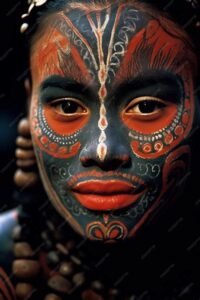
Source : Govt. of India tribal photo
There are over 645 tribes who are the original inhabitants of India. Most of them remain poor and isolated due to their lack of education and skills that are required to get jobs and a way out of their poverty. But they remain resilient and proud of their culture and heritage that they try to preserve against all odds. The blog looks at some of them and their unique lifestyle to make people appreciate them.
Today I present to you 4 videos with English narration and subtitles to show you the beauty of the tribes of Kutchch in Gujrat and in Rajasthan of India in all its glory. There are over 645 tribes living in India as per the census. The twenty most recognized tribes are shown below. It is not possible to write about all the tribes in India so a few are chosen for this blog to give you some information on them.
The tribes are the original inhabitants of India who have their history dating back thousands of years. They have remained isolated , mostly uneducated and limited to their tribal lands that now face serious threat from encroachment from outsiders. The government now makes it easier for them to get education and jobs. It provides them training in new skills that can get them jobs and a better way of life. They have helped Ram build the causeway between India and Lanka ( now called Sri Lanka) that Ram's army crossed to fight the King Ravana and rescue Sita but the Ramayana describes them as monkeys denigrating them as sub humans.
But the tribals are known for their resilience, their beauty in women and their survival skills in harsh environment. Their way of life is under pressure in modern India but they try to remain faithful to their culture, language, their ethnic clothes, their art and handicraft that they sell to make a living.
In the last part of this blog I present to you four incredible videos on the tribes of Gujrat and the nomads called the Rabaris on Rajasthan.
Major Tribes in India (State-wise)
| State | Major Tribes |
| Arunachal Pradesh | Aptani, Mishmi, Daffla, Miri, Aka, Sinpho, Khamti Nyishi etc. |
| Assam | Chakma, Mikir, Kachari, Bora , Bodo etc |
| Meghalaya | Garo, Khasi, Jaintia, Hamar etc |
| Nagaland | Angami, Konyak, Lotha etc |
| Manipur | Kuki, Lepcha, Mugh etc |
| Tripura | Bhutia, Chakma, Garo, Kuki etc |
| Mizoram | Mizo, Lakher etc |
| West Bengal | Asur, Bhumij, Birhor, Lodha, Lepcha, Magh, Mahali, Malpaharia, Polia , Santhals , Toto etc |
| Jharkhand | Santhal, Paharia, Munda, Ho, Birhor, Oraon, Kharia, Tamaria etc |
| Uttar Pradesh & Uttarakhand | Tharu, Bhatia, Jaunsari, Bhoksha, Raji, Khasa, Bhuia, Kharwar, Manjhi, Kol etc |
| Odisha | Zuang, Sawara, Karia, Khond, Kandh etc |
| Madhya Pradesh and Chhattisgarh | Hill Maria, Muria, Dandami, Gond, Baiga. Parja, Bhattra, Agaria, Bhil, Saharia. Korwa, Halba etc |
| Himachal Pradesh | Gaddi, Gujjar, Kinnar etc |
| Jammu & Kashmir | Gaddi, Bakarwal etc |
| Rajasthan, Maharashtra | Bhil, Meena. Kathoria, Garasia , Warli etc |
| Andhra Pradesh and Telangana | Chenchu, Yandai, Kurumba, Khond, Bagdaz, Koya, Bagata, Gadaba etc |
| Kerala, Karnataka | Irula, Kurumban, Kadar, Puliyan , Kodava, Soliga , Siddis etc |
| Tamil Nadu | Kota, Kurumba, Badaga , Toda etc |
| Andaman & Nicobar | Great Andamanese, Nicobarese, Onge, Jarawa, Shompen, Sentenalese etc. |
Note : The tribes mentioned below are highlighted in the list above in bold letters.
The photos and the information related to them come from the Indian Government website.
There are over 645 tribes who are the original inhabitants of India. Most of them remain poor and isolated due to their lack of education and skills that are required to get jobs and a way out of their poverty. But they remain resilient and proud of their culture and heritage that they try to preserve against all odds. This looks at some of them and their unique lifestyle to make people appreciate them.
Today I present to you the beauty of the tribes of Kutch in Gujarat and in Rajasthan of India in all its glory. There are over 645 tribes living in India as per the census. The twenty most recognized tribes are below. It is not possible to write about all the tribes in India, so a few are chosen for this to give you some information on them.
The tribes are the original inhabitants of India, who have their history dating back thousands of years. They have remained isolated, mostly uneducated and limited to their tribal lands that now face serious threat from encroachment from outsiders. The government now makes it easier for them to get education and jobs. It provides them training in new skills that can get them jobs and a better way of life. They have helped Ram build the causeway between India and Lanka (now called Sri Lanka) that Rams army crossed to fight the King Ravana and rescue Sita, but the Ramayana describes them as monkeys, denigrating them as sub-humans.
But the tribals are known for their resilience, their beauty in women and their survival skills in harsh environment. Their way of life is under pressure in modern India, but they try to remain faithful to their culture, language, their ethnic clothes, their art and handicraft that they sell to make a living.
Major Tribes in India (State-wise)
State | Major Tribes |
Arunachal Pradesh | Aptani, Mishmi, Daffla, Miri, Aka, Sinpho, Khamti Nyishi etc. |
Assam | Chakma, Mikir, Kachari, Bora, Bodo etc |
Meghalaya | Garo, Khasi, Jaintia, Hamar etc |
Nagaland | Angami, Konyak, Lotha etc |
Manipur | Kuki, Lepcha, Mugh etc |
Tripura | Bhutia, Chakma, Garo, Kuki etc |
Mizoram | Mizo, Lakher etc |
West Bengal | Asur, Bhumij, Birhor, Lodha, Lepcha, Magh, Mahali, Malpaharia, Polia, Santhals, Toto etc |
Jharkhand | Santhal, Paharia, Munda, Ho, Birhor, Oraon, Kharia, Tamaria etc |
Uttar Pradesh & Uttarakhand | Tharu, Bhatia, Jaunsari, Bhoksha, Raji, Khasa, Bhuia, Kharwar, Manjhi, Kol etc |
Odisha | Zuang, Sawara, Karia, Khond, Kandh etc |
Madhya Pradesh and Chhattisgarh | Hill Maria, Muria, Dandami, Gond, Baiga. Parja, Bhattra, Agario, Bhil, Saharia. Korwa, Halba etc |
Himachal Pradesh | Gaddi, Gujjar, Kinnar etc |
Jammu & Kashmir | Gaddi, Bakarwal etc |
Rajasthan, Maharashtra | Bhil, Meena. Kathoria, Garasia, Warli etc |
Andhra Pradesh and Telangana | Chenchu, Yandai, Kurumba, Khond, Bagdaz,Koya, Bagata, Gadaba etc |
Kerala, Karnataka | Irula, Kurumban, Kadar, Puliyan, Kodava, Soliga, Siddis etc |
Tamil Nadu | Kota, Kurumba, Badaga, Toda etc |
Andaman & Nicobar | Great Andamanese, Nicobarese, Onge, Jarawa, Shompen, Sentenalese etc. |
A few of these tribes are mentioned below, The photos and the information related to them come from the Indian Government website.
1. Gond tribe, Orissa

Gond tribal women with hair ornaments, nose ring and beads necklace
Known for their valor, the Gond tribes are mostly found in Central India in the Chhindwara district of Madhya Pradesh. They are also found in the Bastar district of Chhattisgarh, parts of Maharashtra, Andhra Pradesh, and Orissa. The Gond tribes have a good command over Telugu, Hindi, Marathi, Parsi and many other Dravadian languages.
They are known for their colour, with mud walls and thatched roof houses, earthen pots, traditional attire men in dhoti and women in sari and ornaments, and their ritual performances in the festivals of Keslapur Jathra and Madai.
2. Bhils
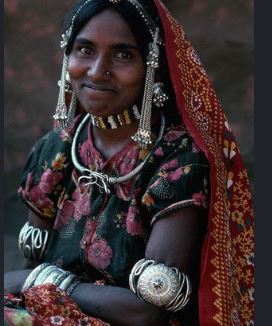
Bhil woman with silver jewelries
This tribal community is mostly found in the Aravalli Ranges of Sirohi in Udaipur and some places of Dungarpur and Banswara districts of Rajasthan. The Bhil tribe settlements are also found in parts of Gujarat, Madhya Pradesh, Maharashtra and Tripura.
The cultural harmony Ghoomar dance, Than Gair (a religious dance and drama) and Baneshwar Fair that is held in the month of January or February are major attractions.
3. Santhal tribes
The Santhal tribes are the oldest tribes in India. They are the major tribes of West Bengal and are mostly seen in the districts of Bankura and Purulia. They are also widely seen in parts of Bihar, Jharkhand, Odisha and Assam. The Santhals are largely dependent on agriculture and livestock; further, they are well versed in the art of hunting.
The Santhali dance and music is one of the major attractions in Bankura and Purulia. Festivals like Karam, Maghe, Baba Bonga, Sahrai, Ero, Asaria, Disum Sendra and Namah are worth experiencing.
4. Great Andamanese tribe Jarawa
Jarawa tribe of Andaman
The Great Andamanese Tribe, which includes the Onge, Jarawa, Jangil and Sentinelese, are said to be the first inhabitants of the islands. But today, a significant number is on its way to extinction. Nonetheless, the leftover population of the Great Andamanese are largely dependent on the vigorous campaign by survival and Indian organizations. The Great Andamanese are mostly in Strait Island and parts of Rutland Island.
5. Khasi
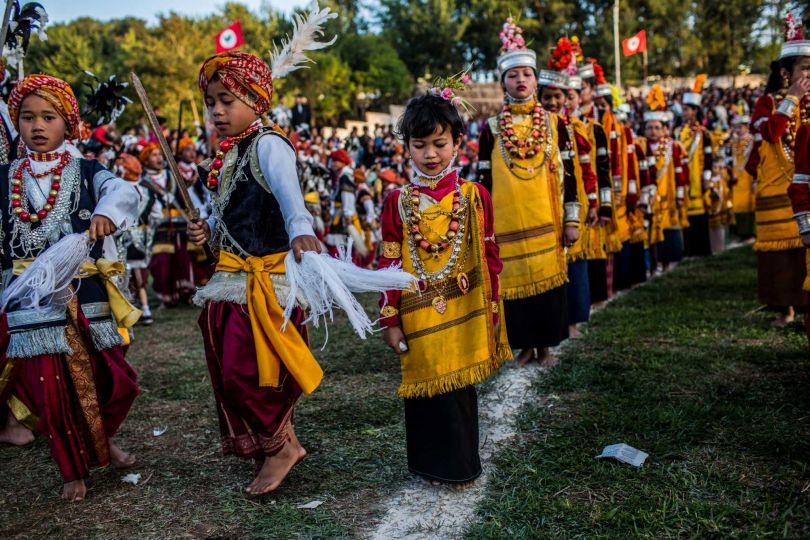
The Khasi tribes where women dominate
In the mountains of Meghalaya, the music of the Khasi tribes playing drums, guitars, flutes, wooden pipes and metal cymbals abounds. The Khasi tribes are mostly found in the Khasi Hills of Meghalaya and are also found in parts of Assam, Arunachal Pradesh, Manipur and West Bengal.
The language, which is an Austro-Asiatic language and dress Jainsem for women and Jymphong for men. The Nongkrem festival is a five-day-long extravaganza.
6. Garo

tribes sing and dance with drums beatings
The Garo are one of the few remaining matrilineal societies in the world, in the hills of Meghalaya. They are also in the neighboring areas of Bangladesh and parts of West Bengal, Assam and Nagaland. Women are often found in varieties of traditional ornaments, whereas men are seen wearing turbans with feathers stuck behind them.
7. Angami
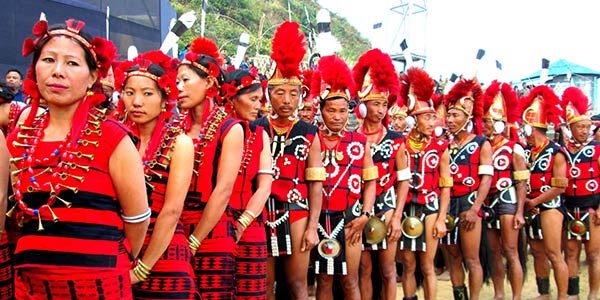
Angami tribe loves the colorful dress for dancing
The Angami Nagas are one of the major tribes of Nagaland, widely present in the district of Kohima. The Hornbill Festival is a major attraction that showcases their intricate and beautiful woodcraft and artwork. The Angami Nagas are known for the producer of bamboo work, cane furniture, beds, shawls and powerful machetes, and unique pork dishes. Their dressing style is unique men in white Mhoushu and black Lohe and women in Mechala along with ornaments like beads, miniature mask pendants, bangles and bracelets.
8. Munda
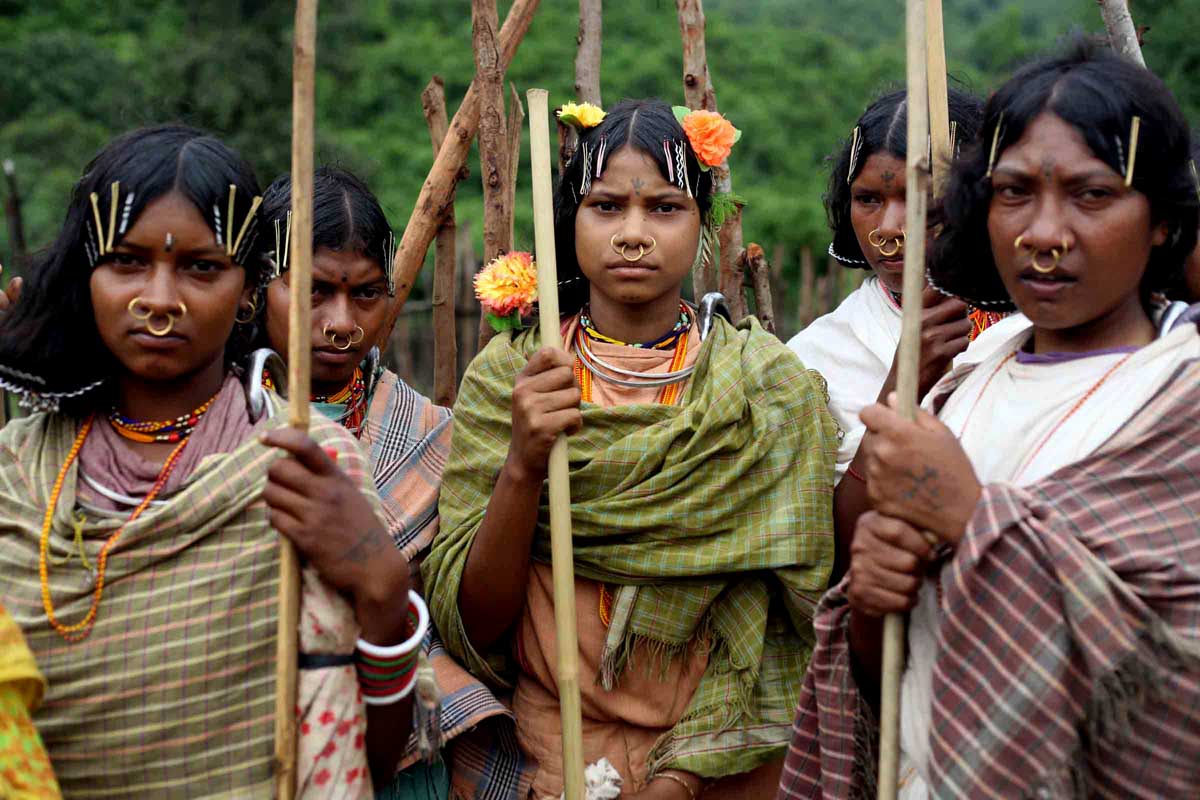
Munda tribe
The Munda settlement is largely based in the Chota Nagpur Plateau region, mostly in the densely populated Jharkhand, as well as parts of West Bengal, Chhattisgarh, Bihar, Odisha. The Munda tribes speak Killi and live a simple lifestyle that follows the Sarna religion, believing in a God called Singbonga.
Mage, Phagu, Karam and Sarhul are the major festivals, with the Nupur dance a highlight.
9. Bhutia
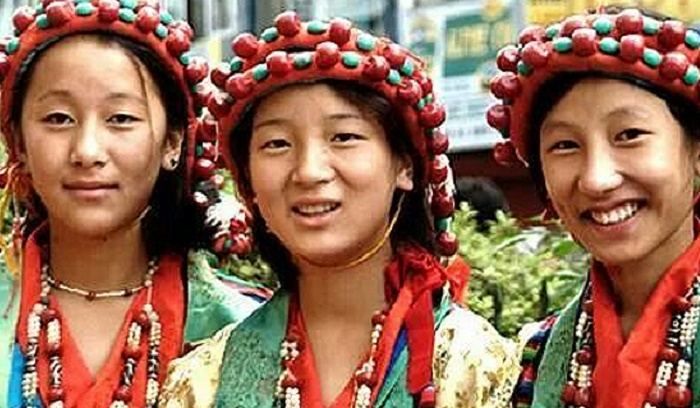
Bhutia girls dress up for festivals
Dominating the landlocked territory of Sikkim that borders the Indian Himalaya, the Bhutias are widely known for their traditional art and cuisine. The unique preparation of momo, steamed meat dumplings and thukpa, even spicy beef. During the Losar and Losing festival they showcase their dance, music and religion.
10. Chenchu
Chenchu tribe with silver jewelries
The Chenchu tribes are one of the indigenous people of Andhra Pradesh, inhabiting the forests of Nallamala Hills. They are mostly seen in the districts of Mahboobnagar, Nalgonda, Prakasam, Guntur and Kurnool. They are largely dependent on hunting and trading jungle products like roots, tubers, fruits, beedi leaves, mahua flower, honey, gum, tamarind and green leaves. Other than the languages having Telegu accent, they are skilled in various form of arts and crafts.
11. Kodava
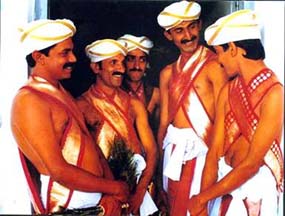
Kodava tribe
One of the distinct races in India, the Kodava tribes, are known for their bravery. Coorg is flourishing as one of the ecotourist destinations in India, attracting weekenders from nearby cities of Karnataka. The Kodava tribes are fond of music and dance, famous for the festivals of Puttari, Kaveri Sankramana and Kailpodhu. These people are also passionate about hockey with both men and women playing the game. The Kodava Hockey Festival is held every year.
12. Toto
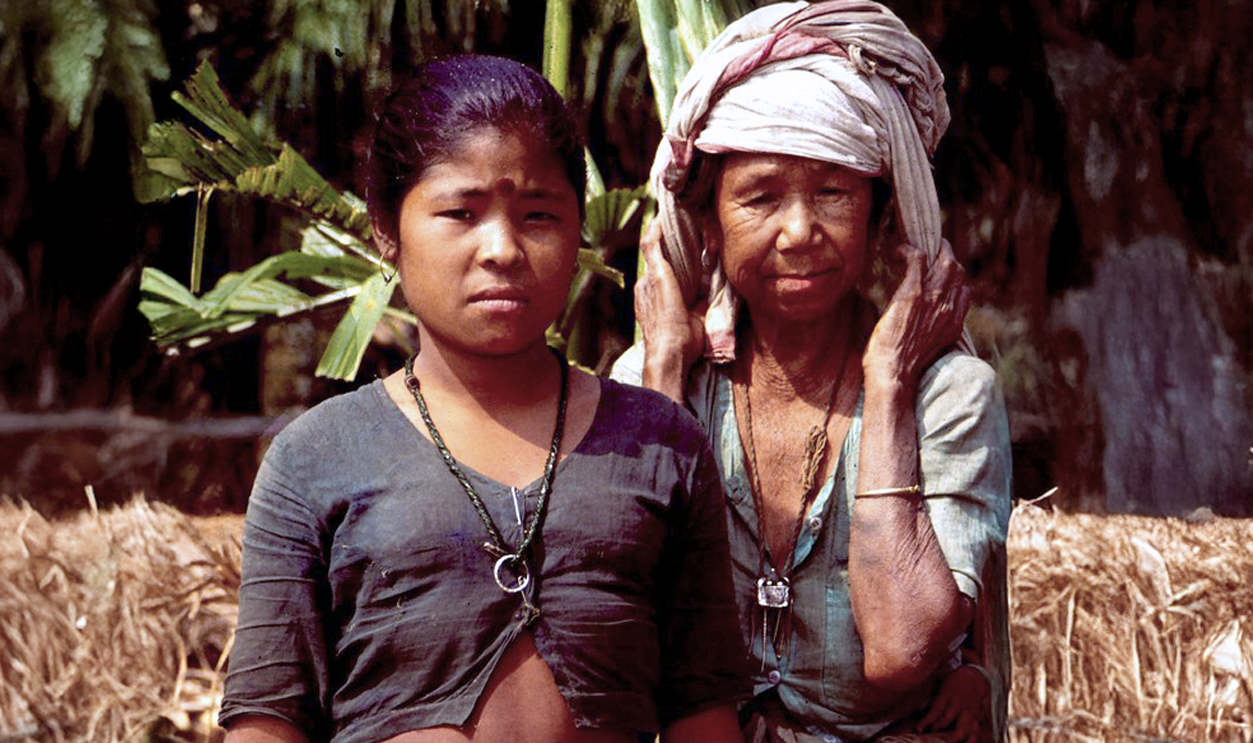
Toto tribal women
One of the isolated tribal groups inhabiting the village of Totopara in Jalpaiguri district of West Bengal is the Toto tribes. They have a simple lifestyle and are largely dependent on trading vegetables and fruits. In spite of the fact that they define themselves as Hindus, the Totos are believers of god Ishpa and goddess Cheima. Jaldapara National Park is one of the popular national parks in India that is located approximately 20 kilometers from Totopara. Eu is a type of country liquor made from fermented marua, rice powder and malt and is served warm in Poipa (wooden glass).
13. Irulas
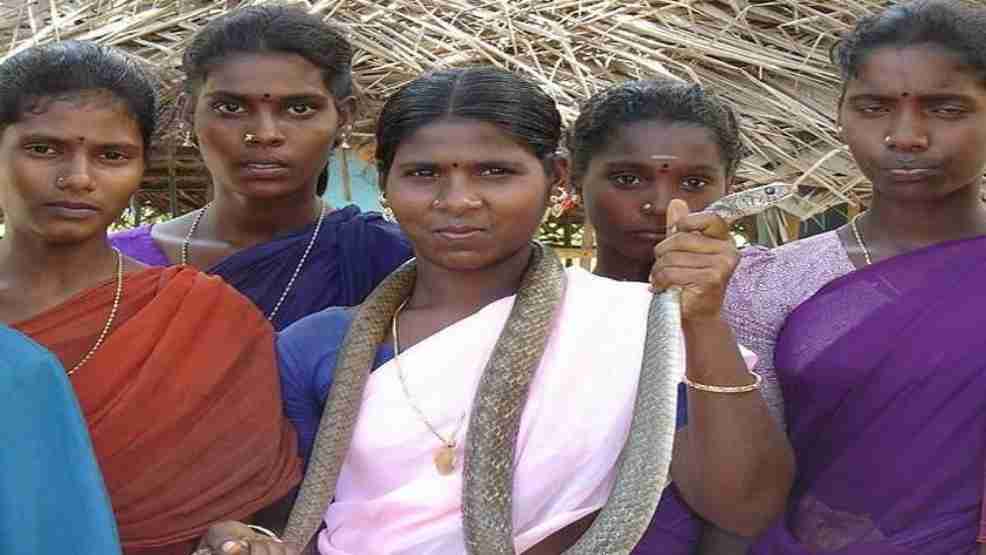
Irulas women holding a snake
The Irulas are a South Indian tribe who have traditionally based their livelihood on being snake catchers. With a population of approximately 3,00,000 the Irulas inhabit parts of Tamil Nadu, Karnataka, Andhra Pradesh and Kerala. Moreover, the Irulas are the second-largest tribe in Kerala and are mostly seen in the district of Palakkad. The Irulas are largely dependent on agricultural products like paddy, ragi, dhal, plantains, chilies, and turmeric. Further, the major attraction remains their varied ritual performances. Although most of them are Hindus, but they still believe in worshiping their own deity, Irulas are also known to be conversant in white and black magic.
14. Nyishi

Nyishi women in colorful dress and ornaments
The Nyishi tribes are the largest inhabitants of the mountainous state of Arunachal Pradesh and are mostly found in the districts of Papum Pare, Lower Subansiri, Kurung Kumey, East Kameng, parts of Upper Subansiri. Whilst a majority of them have converted to Christianity, their religion still involves a belief in spirits associated with nature. The Nyokum Festival, which is dedicated to goddess Nyokum, held in the month of February, is a major attraction.
15. Bodo

Bodo tribe ready for dance and drums
Believed to be the early settlers of Assam, the Bodo tribes today are found in Udalguri and Kokrajhar of Assam and parts of West Bengal and Nagaland. If you are keen to seek the traditional colors of the Bodo people, then travel to North East during the time of the Baishagu Festival, dedicated to Lord Shiva (locally known as Bathou), which is celebrated during spring season every year. Further, the Bodo tribes have unique preparations of pork and fish. Hand-loom weaving is one of the most intrinsic parts of Bodo culture.
16. Warli

Warli tribe men
The Warli or Varli tribes of Maharashtra and Gujarat display a unique form of art and painting that reflects the mural paintings of 500 10,000 BC carved in the Rock Shelters of Bhimbetka in Madhya Pradesh. Their form of art follows the rudimentary technique with a mixture of earth and cow dung, branches, red ochre, rice paste, bamboo stick and more. Visit during the Warli Folk Art Dancing People Festival, which is held during the month of March every year. The Tarpa Dance is a folk dance performed during the harvest season.
17. Toda

Toda woman
The Toda people are a small pastoral community who live on the isolated Nilgiri plateau of Southern India.
Dominating parts of the Nilgiri Mountains, the Toda tribes are largely dependent on cattle-herding and dairy-work. They are also skilled in art and architectural works like embroidery products and dogles, a type of oval and pent shaped huts made of bamboo canes and thatched roof. Ooty, which is one of the popular hill stations in South India, has several such Toda huts as well as people inhabiting the area.
18. Kurumban
Kurumban tribe
Another major tribe dominating parts of Kerala and Tamil Nadu, the Kurumban tribe exhibits a simple lifestyle, depending largely on agricultural products. They are widely known for traditional herbal medicines, witchcraft and magical performances.
19. Soliga
Soliga tribe
Inhabiting the dense forest of BR Hills of Karnataka and Tamil Nadu, the Soliga tribes are yet another indigenous group of people, further divided into five subgroups Male Soliga, Urali Soliga, Pujari, Kadu and Burude. Towards Bandipur National Park, you may chance upon the Kadu Soliga tribes.
20. Siddis

Siddi tribals celebrating with dance
The Siddi tribes of Karnataka are believed to have descended from the Bantu people of Southeast Africa, who were treated as slaves by Portuguese merchants. Today, the Siddi people are predominantly found around Yellapur, Haliyal, Ankola, Joida, Mundgod, Sirsi, Belgaum and Dharwad in Karnataka apart from some pockets of Pakistan. The Siddi people are mostly Roman Catholic, but some follow Hinduism and Islam.
The major attraction remains their ritual practices, dance and music.
I hope that you will find this informative about the few tribes mentioned here.
https://youtu.be/jI2SWCqAk3w
Source : U tube video of Kutchch tribe and their culture
https://youtu.be/oNXussdJxkI
Source : U tube video of tribe in Kutchch and their needle craft
The following two videos are on the nomadic tribe of the Rabaris who are found in Rajasthan as well as in Pakistan border area. They are known for their resourcefulness living in the desert conditions of Rajasthan where they eke out a meager living but maintain the colorful culture, their lifestyle and their handicraft. They are nomads so they move around a lot looking for grazing lands for their animals and water.
https://youtu.be/eLgg9KotKfg
Source : U tube video of Rabari nomads
https://youtu.be/NwuswcVni_w
Source : U tube video of Rabari nomads and their ornaments
I hope that you will find the blog informative about the few tribes mentioned here and share the blog with anyone you like.
Note : My blogs are also available in French, Spanish, German and Japanese languages at the following links as well as my biography. My blogs can be shared by anyone anytime in any social media.
Mes blogs en français.
Mis blogs en espagnol
Blogs von Anil in Deutsch
Blogs in Japanese
My blogs at Wix site
tumblr posts
Blogger.com
Medium.com
Anil’s biography in English.
Biographie d'Anil en français
La biografía de anil en español.
Anil's Biografie auf Deutsch
Anil’s biography in Japanese
Биография Анила по-русскиu


No comments:
Post a Comment